2025-2026 Norway Program
Environmental Issues of Norway


Biodiversity loss in Norway - By Zarah Khan and Jonas Kwiet
Due to several factors, one of which being invasive species such as the Sitka Spruce, many Norwegian species, such as the Norwegian Spruce, have been threatened. The invasive Sitka Spruce has been increasing competition and depleting other plants of nutrients from the soil. The current policies regarding Sitka Spruce are not extensive, and those that exist contain gaps, thus requiring further efforts to address the growing amount of this invasive species.


Green Colonialism of the Sami People - By August Blaustin and Margot Doubleday
The Sami people are an indigenous group who span across Northern Scandinavia. In Norway, the government has placed wind turbines concentrated on the lands of the Sami people, which has violated the Sami people's reindeer herding rights. Fortunately, the government is taking steps towards mitigating this breech of environmental justice through recent agreements made with the Sami people.


Foreign Oil Export Crisis of Norway - By Kamille Maigaard and Tale Myhren
While domestically, Norway's usage of greenhouse gases is relatively low, this is directly contradicted by the fact that in 2024, it exported about 1.6 million barrels of crude oil per day to foreign nations. These exports are a crucial component of Norway's economy, and therefore make it difficult to limit through policy. However, taking action towards aiding this issue is critical toward benefiting the climate cause in Norway.


Acid Rain in Southern Norway - By Chris Lango and Minea Ahlfors
Acid rain has caused extensive damage throughout Scandinavia, particularly in Southern Norway. Pollution, energy, wastage, and refusing to support environmental policies have been the main driving forces in prolonging this problem. Fortunately, through emission reduction and international cooperation, the effects of acid rain can me mitigated before it creates irreversable damage.


Marine Pollution in Norway - By Tova Nygren and Agustin Velasco
One of Norway’s most pressing environmental issues is marine pollution. This involves extensive use of fish farming, noise pollution disrupting migration patterns, pollution involving fishing gear, seabed sediment, and oil runoff. While there are a number of policies that are being implemented to mitigate the damage of marine pollution, the number of policies working to prevent the damage in the first place is limited. Thus, pushing for such policies is crucial.
Actions and Speakers
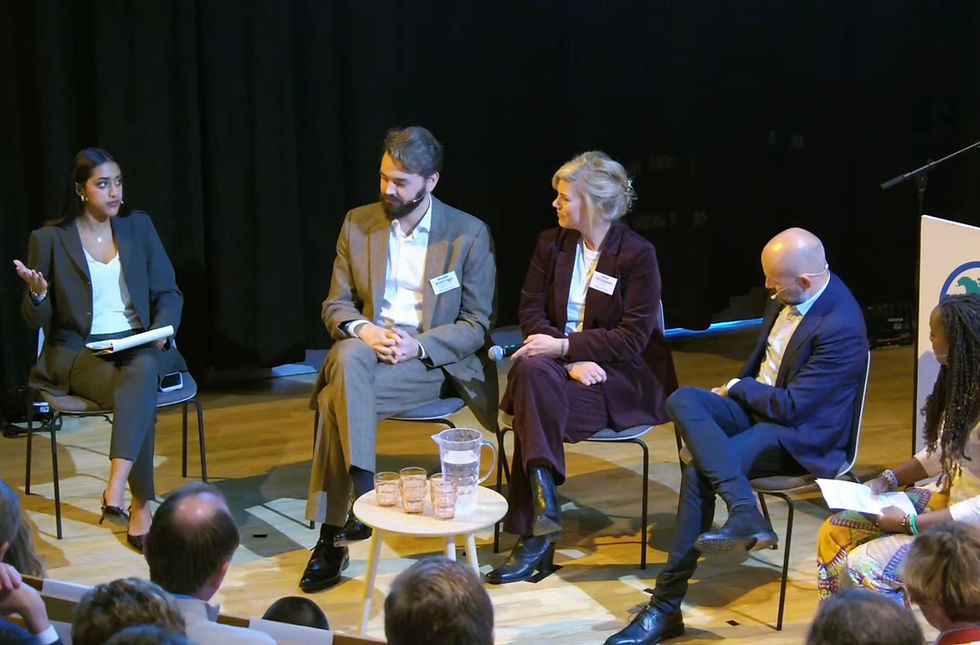

Bendik Egge, Director of Education at the Nobrl Peace Center

Queen Sonja of Norway
Queen Sonja of Norway Visit and Human Rights Speaker Panel
UWC Red Cross Nordic celebrated its 30th anniversary, joined by many distinguished guests, including Her Majesty, Queen Sonja of Norway. I had the honor of moderating a panel discussion on democracy, dialogue, and peace, featuring Jette Christensen, former member of the Norwegian Parliament, Bendik Egge, Director of Education at the Nobel Peace Center, and Jostein Kobbeltvedt, Executive Director of the Rafto Foundation. The discussion covered a
wide range of topics, including social and climate-based environmental causes pertaining both to Norway specifically as well as the globe. Other speakers beyond the panel include Siri Hatlen, President of the Norwegian Red Cross and Faith Abiodun, Executive Director of UWC International.


Promoting Biodiversity in Norway's Solund Municipality
The Solund municipality in Norway faces environmental challenges regarding loss of biodiversity due to the invasive plant species, Sitka Spruce. Many local practices work to prevent this outcompeting of native plants, including wild sheep grazing and cutting or burning down the trees. LEAP traveled to Solund to gain firsthand experience in such practices, clearing the land of invasive plant species and enabling sheep grazing (as sheep eat and remove overgrowing habitats and vegetation).


Climate Action and Policy-Making Panel
LEAP was recently joined by four expert speakers to hear about the intersections of the climate cause across sectors such as business, technology, urban development, and policy. Dr. Muller, Dr. Riandita, Mr. Brunner, and Dr. Chavan informed participants of LEAP about topics such as fast fashion, carbon capture, food waste, oil experts, climate policy-making, and more. Participants found the panel session informative, engaging, and effective in providing vast knowledge in various sectors and the capabilities
of youth to make and impact as changemakers. Read more about the guest speakers and the student reviews.